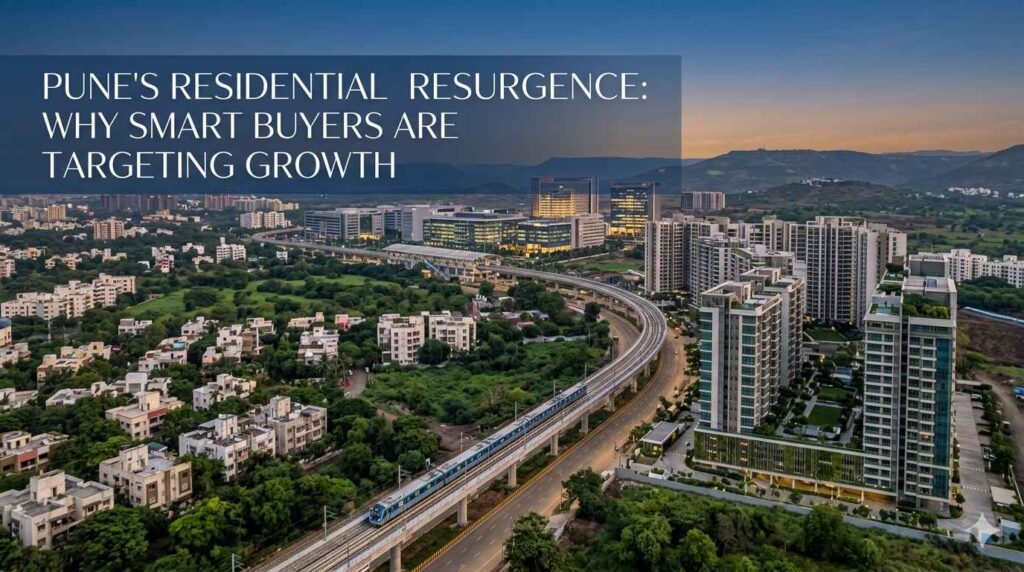
Pune’s commercial real estate market is entering a more mature phase.
The city is no longer competing simply on affordability or its traditional strengths in IT, engineering and manufacturing. It is increasingly competing for global businesses, high-skilled talent and strategic corporate functions-and that is changing the nature of demand for office space.
The numbers tell an important story.
According to Cushman & Wakefield’s Q2 2026 Pune MarketBeat, the city recorded 5.31 million sq. ft. of gross office leasing in H1 2026, including 3.22 MSF in Q2 alone. GCCs remained a major demand driver, while flexible workspace operators, IT-BPM and BFSI also contributed significantly to activity. (Cushman & Wakefield)
JLL’s Q2 2026 assessment provides another useful perspective: Pune recorded 3.2 MSF of quarterly net absorption, three times the year-earlier level, even as 3.25 MSF of new supply entered the market. Vacancy consequently declined to 16.7%. (JLL)
That combination matters.
New supply is entering. Demand is absorbing it. Quality remains important.
What is driving Pune’s office market?
Pune’s commercial real estate demand is increasingly diversified.
Technology remains important, but the occupier base is expanding into BFSI, engineering and manufacturing, healthcare, telecommunications, flexible workspace and Global Capability Centres. Across India, GCCs leased 16.5 MSF in H1 2026, with Pune accounting for approximately 3.01 MSF, placing it among India’s leading GCC markets. (Cushman & Wakefield)
This diversification is significant because different occupiers create different requirements.
A conventional office requirement may prioritise cost and location.
A global GCC may additionally evaluate floor-plate efficiency, technology infrastructure, employee experience, sustainability, security, parking, vertical mobility, expansion flexibility and access to talent.
That is gradually changing what “good office space” means in Pune.
Which commercial corridors matter?
Pune’s office market is not one homogeneous market.
SBD East—including the Kharadi ecosystem-remains one of the city’s most important commercial destinations. PBD West, including the Hinjewadi and surrounding western corridor, is another major employment cluster. Other locations including Baner-Balewadi, Hadapsar, Viman Nagar and Kalyani Nagar continue to benefit from established corporate ecosystems and improving connectivity.
The next phase, however, will be influenced not only by existing employment clusters but also by infrastructure.
Road upgrades, Metro expansion and major connectivity projects can change the effective distance between talent, businesses and workplaces.
That is why commercial real estate should not be viewed independently from urban infrastructure.
What does this mean for occupiers?
The Pune office market is becoming more discerning.
The question is moving from:
“How much space do we need?”
to:
“What kind of workplace will help our business perform better?”
That is a significant shift.
The next generation of Grade-A offices will increasingly need to combine engineering, sustainability, technology, employee experience and adaptability rather than relying solely on location and aesthetics.
For businesses evaluating commercial office space in Pune, this distinction is becoming increasingly important.
Where does Siddhesh Developers fit?
This evolution is precisely why quality commercial development matters.
Orville Business Port in Viman Nagar, developed by Siddhesh Developers, offers Grade-A commercial office space, with select units currently available for lease and select floor plates in its newer wing available for purchase.
For businesses and investors looking at Pune’s evolving commercial landscape, it is worth watching what comes next from Siddhesh Developers as the company prepares to introduce one of its largest Grade-A commercial developments in Baner.
Pune’s commercial story is getting bigger.
The standard of its workplaces needs to get higher with it.